
The 2026 conservation survey of the Greenhead Park Cenotaph has begun.
A heritage conservator from York has been retained to carry out the first full assessment of the Memorial stonework since 2009. The findings will shape our maintenance budget for the next decade and a half. By Stephen Michael Armitage, Chair.
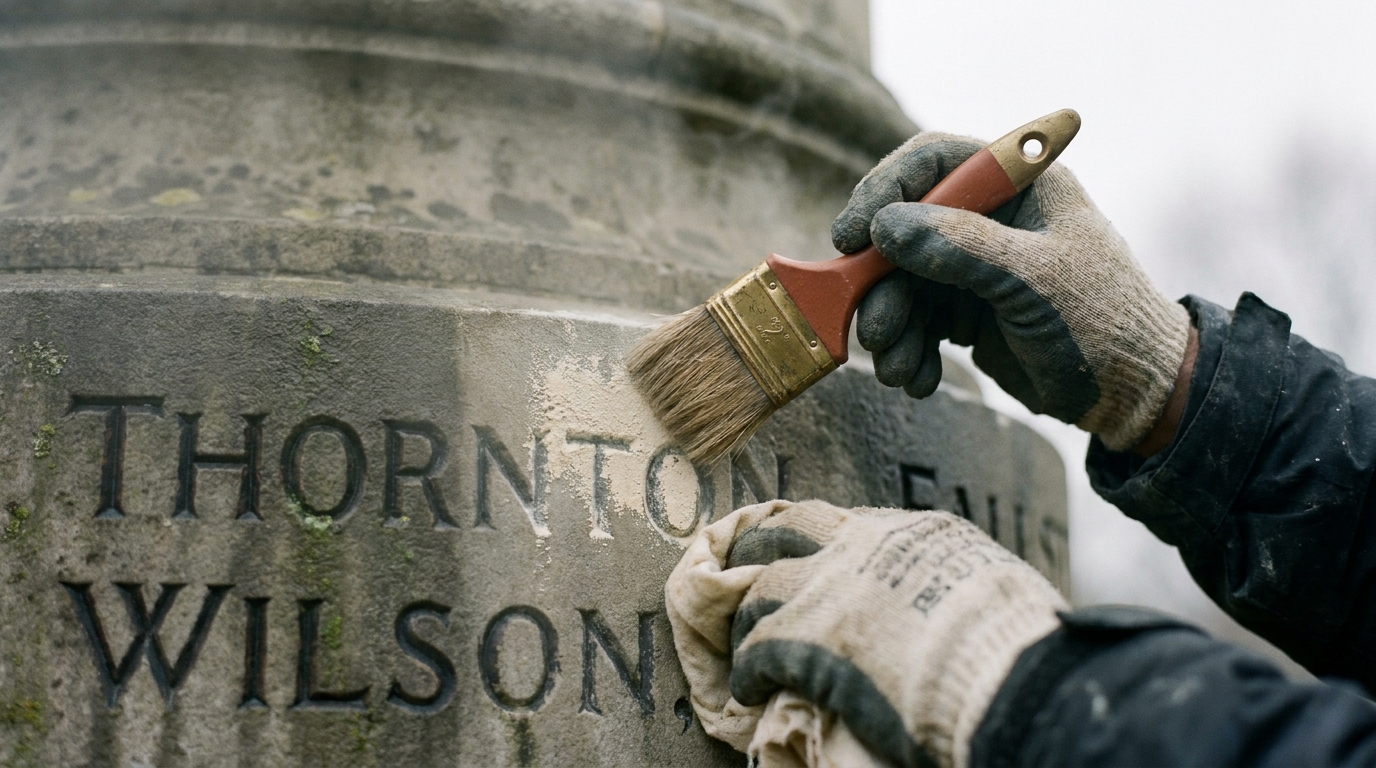
A century is a long time to leave a stone outdoors in West Yorkshire. The Cenotaph at Greenhead Park has stood since May 1924, weathered the smoke of an industrial town and the slow cleaning of the air that followed, taken on the lichen the Pennine wind always finds, and held the names of three thousand four hundred and thirty-nine Huddersfield neighbours through every winter since. It is in better condition than it has any right to be. That is no accident. It is the work, mostly invisible, of every stonemason and Friends-of-Greenhead-Park volunteer who has spent an hour with a soft brush at its base since the dedication.
The last full conservation survey we commissioned was in 2009. That report, written by a specialist in inter-war municipal monuments, has shaped sixteen years of our maintenance spending. We followed its recommendations: a careful repointing in 2012, a cleaning regime each October before Remembrance Sunday, a slow programme of inscription-recutting on the lower drum where the south face takes the worst of the weather. The 2009 report ended with a sentence we have read often: ‘A further full assessment should be commissioned no later than 2025, sooner if any sign of fracture, salt migration or differential weathering is observed.’
We have not seen the signs the 2009 report warned us to look for. The names remain legible. The base is sound. But the recommendation stood, and at our November 2025 meeting the trustees agreed that the time had come. We approached three conservators with experience of similar municipal memorials in the north of England, asked for short proposals, and accepted the proposal from York Conservation Studio in early February. Work began on site on Monday 16 March 2026.
It is in better condition than it has any right to be. That is no accident. It is the work, mostly invisible, of every stonemason who has spent an hour with a soft brush at its base since 1924.Stephen Michael Armitage · Chair
The conservator’s brief is unusually narrow, by design. We do not want a wish-list document we cannot afford. We have asked, in plain terms, for three things: an honest visual and tactile assessment of every face of the Memorial; a small number of carefully chosen non-destructive tests (moisture readings, surface salt readings, a single thermography pass); and a maintenance plan that costs no more than two thousand pounds a year to deliver over the next fifteen years. We have been clear that if the assessment uncovers a major fracture or a structural concern we have not seen, the maintenance plan can be replaced by a separate priority report. Our budget is what it is.
Why now
The bare answer is that 2009 plus sixteen years is 2025, and our trustees do not believe in postponing carefully-scheduled stewardship. The longer answer is that we have noticed something it took us a year of conversations to put into words: the names on the south-east panels are starting to feel different under the fingers. Read them and you can still hear the syllables. Touch them and you can feel that they are no longer quite as crisp as they were a decade ago. A trustee with conservation experience suggested last autumn that this could be early-stage gypsum crust, the slow chemistry that happens where weathered limestone meets sulphur-laden rain. It may be nothing. It may be a small problem caught in time. The survey is how we find out.
The fundraising
The survey, the on-site work, and the production of the maintenance plan will cost £14,400. This is a larger single outlay than the trust is used to making in a year, and it does not fall comfortably within our usual annual budget. We have therefore opened a separate appeal — the 2026 Conservation Appeal — which has been open since the start of February. As of this writing we have received £9,680 of the £14,400 target, drawn from sixty-eight individual gifts. The largest was £1,500, given anonymously. The smallest was £2, sent by post with a hand-written note from a Slaithwaite reader of our quarterly dispatch.
If you would like to contribute to the appeal, the donation page is the simplest route. If you would prefer to give by cheque, made payable to The Huddersfield War Memorial Trust Fund, our registered office address is on the contact page. We will acknowledge every gift by post; we will publish a brief end-of-appeal note as soon as the target is reached; and we will not chase you with further appeals for at least the next two years if you ask us not to.
What happens next
The conservator’s work on site will take three weeks, spread across March and April, with a quiet pause around the Easter weekend. We expect the written report to reach the trustees in early June. We will publish a short, plain-English summary of the findings on this page within a fortnight of receiving it, alongside the actions we are planning. If the report recommends repair work that we are able to fund within the year, that work will be commissioned in time for the October cleaning before Remembrance Sunday. If anything more substantial is needed, we will say so.
It is our hundred and fourth winter in charge of the Memorial. It is also, very likely, the slowest, quietest piece of stewardship most of us will ever undertake. The names are not going anywhere. Neither are we.