A narrow remit, kept honestly.
Our charitable objects were written down on 9 May 1922 and amended once, in 1957. They have not changed since. They are deliberately small. They are deliberately local. And they are how we judge every grant request we receive.
The Declaration of Trust, in plain English.
The Charity Commission record states our charitable purposes in the language of the original deed. We summarise them here, as we would explain them to a neighbour over a cup of tea.
Support Huddersfield Royal Infirmary.
A standing annual grant of around £4,000 to the Royal Infirmary’s charity, in conversation with the hospital each year, for projects that fall outside the NHS’s own budget — comfort items, garden furniture, a piece of equipment for a day clinic.
Maintain and repair the Memorial in Greenhead Park.
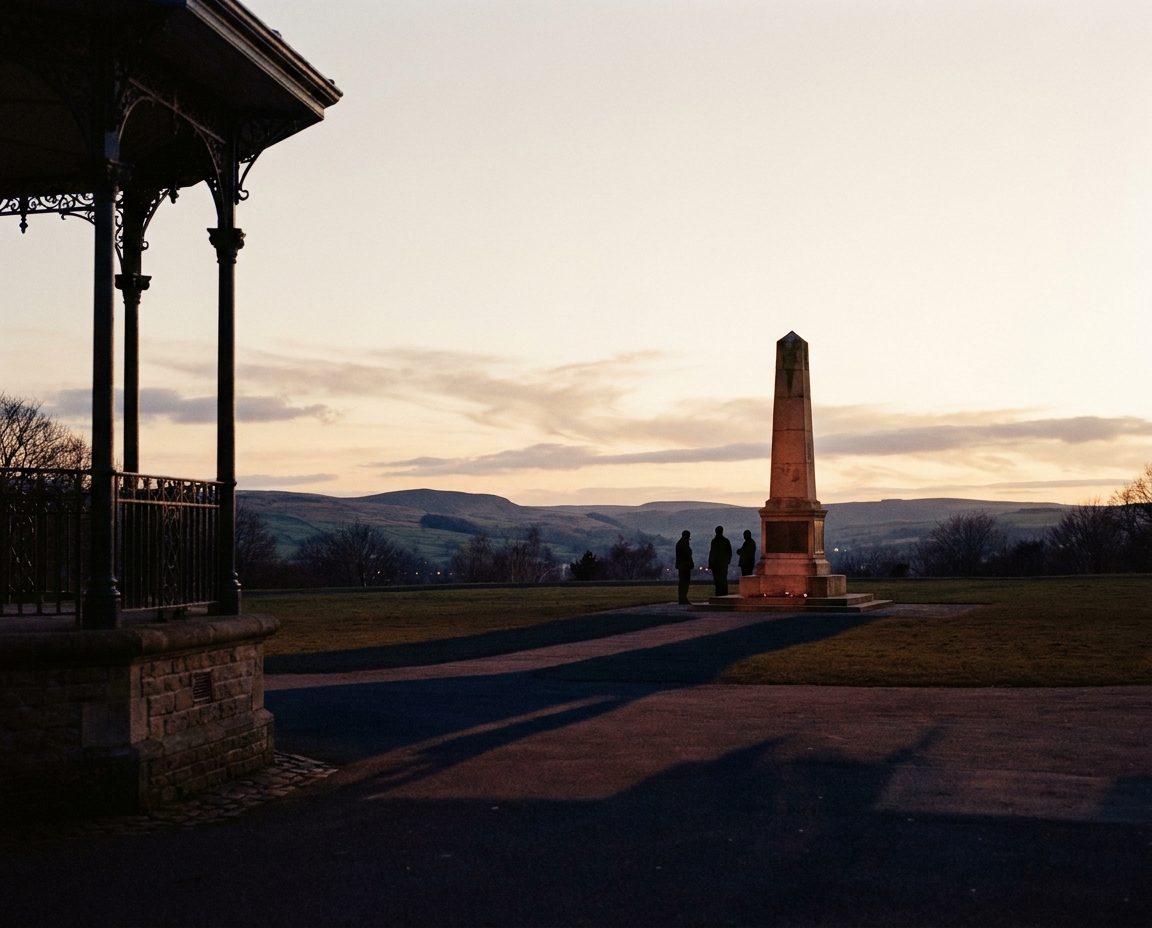
A perpetual responsibility for the upkeep of the Cenotaph, including conservation surveys, stonework, the annual clean before Remembrance Sunday, and the slow, careful recutting of weathered names.
Help those in necessitous circumstances.
Small relief grants — typically £100 to £500 — for the education, maintenance and benefit of individuals and households in necessitous circumstances who live within our area of benefit. Referrals come through trusted local partners.
Support care institutions within twenty miles.
Annual grants to convalescent homes, hospices and institutions caring for the sick, poor and needy located within a 20-mile radius of Huddersfield Town Hall. Our long partnerships in this category are with Forget Me Not, the Welcome Centre, and Holme Valley Memorial Hospital.
From a small annual income to outcomes we can describe in one sentence each.
We have written this in three steps. We update it once a year, after the November trustees’ meeting.
1 · Our inputs
An annual investment income of around £36,000, a small reserve, the time of ten unpaid trustees, and the trust of partner organisations who refer applicants to us.
2 · What we do
We meet four times a year, read every application out loud, and award careful sums to ex-service neighbours, the Royal Infirmary, convalescent homes within twenty miles, and households in necessitous circumstances. We also commission conservation work on the Memorial.
3 · The outcomes
A Cenotaph that is still legible at its centenary. Around forty households eased through a difficult month each year. A hospital with bench space in a garden it could not otherwise afford. A handful of hospices reminded each spring that Huddersfield has not forgotten them.
What we promise the people who write to us.
Reply within ten working days.
Even if the answer has to be no. Silence is a discourtesy we cannot afford to offer to anyone in difficulty.
Ask only what we need.
A short form, a phone call, and a referral letter where appropriate. We do not require photo evidence of necessity.
Keep the boundary.
If a request falls outside our charitable objects we will say so, and where we can, suggest a charity better placed to help.
Account for every pound.
Our accounts are filed with the Charity Commission on time each year, in plain English, with no rounding-up.
Stay small.
We do not seek growth for its own sake. Our scale is the right scale for our remit.
Remember.
The Memorial is the centre. Every other line of work begins from there, and we are conscious of it at every meeting.
The limit of what a trust this size can do.
We turn down about a third of the relief grant applications we receive. Some are outside our area of benefit. Some are for sums we cannot reach. Some are for problems — sustained debt, long-term homelessness, recurring mental ill-health — that one-off grants cannot solve, and we know they cannot. We tried, between 2014 and 2017, to make larger multi-year hardship grants to a handful of households. We learned that without specialist case-workers we did not have, the money could not by itself unwind compound debt. We stopped, with regret, and returned to small one-off relief.
We say this here because we owe it to anyone considering whether to write to us. We are a quiet hardship fund and a small grant-maker, not a service. When we cannot help, we try to say so quickly, and to point onwards where we can.
Three doors in.
Read the programmes. Apply for a grant if your circumstances fit our objects. Or give what you can to keep us small and steady.